
Web Crawling, Indexing Architecture & Crawl Budget Algorithms
Search engines like Google process billions of web pages every day, yet only a fraction of them appear in search results. The journey from publishing a web page to making it searchable depends on three critical processes: web crawling, indexing, and crawl budget management. Understanding Web Crawling, Indexing Architecture & Crawl Budget Algorithms is essential for developers, SEO professionals, and computer science students who want to build websites that are discoverable and performant.
For engineering students, these concepts provide insight into how distributed systems, algorithms, databases, and information retrieval work together behind modern search engines. They also demonstrate how software engineering principles directly influence digital visibility and user experience.
What is Web Crawling?
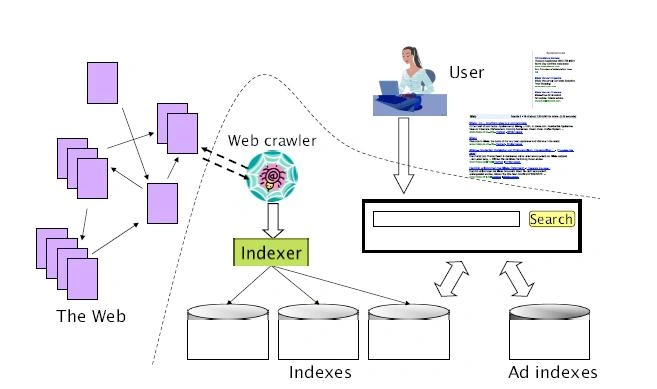
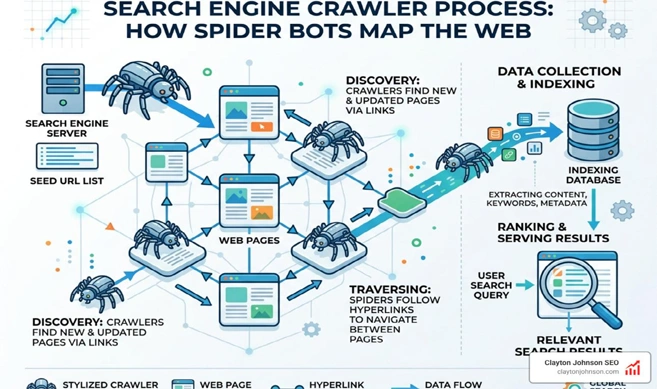
Web crawling is the automated process by which search engine bots (often called crawlers or spiders) discover web pages by following hyperlinks. Crawlers begin with a list of known URLs, visit each page, analyze its content, and continue exploring new links they find.
The objective is to identify new pages, detect updates to existing pages, and collect information for indexing.
Why Crawling Matters
- Helps search engines discover new content.
- Identifies updated pages.
- Supports timely indexing.
- Enables search engines to understand website structure.
- Improves content visibility in search results.
What is Indexing Architecture?
Once a page is crawled, search engines evaluate its quality, relevance, and technical accessibility before deciding whether to store it in their search index.
Indexing Architecture refers to the systems and processes used to organize, classify, and retrieve web content efficiently. Modern indexing systems use distributed databases, machine learning, natural language processing, and ranking signals to create searchable indexes.
A page that is crawled is not automatically indexed. Search engines may exclude duplicate, low-quality, or inaccessible pages.
Understanding Crawl Budget Algorithms
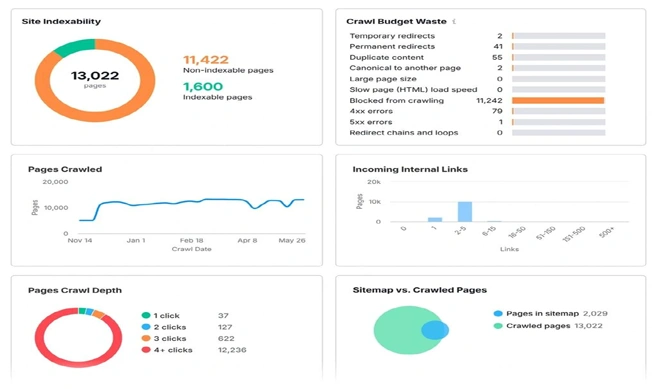
Every website has a limited amount of crawling resources allocated by search engines. This allocation is known as the crawl budget.
Crawl budget is influenced by two main factors:
1. Crawl Capacity
This determines how many requests a search engine can make without overloading the server.
Factors include:
- Server response time
- Website availability
- Hosting performance
- Error rates
- HTTP status codes
2. Crawl Demand
This measures how important search engines consider your pages.
Demand increases when:
- Content is updated frequently.
- Pages receive backlinks.
- Pages attract user engagement.
- New content is published regularly.
How Search Engines Decide What to Crawl
Search engine algorithms prioritize pages based on:
- Internal linking structure
- XML sitemap information
- Canonical tags
- Page freshness
- Content quality
- External backlinks
- Historical crawl data
- User interest
Proper site architecture helps crawlers discover valuable content more efficiently.
Components of an Efficient Indexing Architecture
A well-designed indexing architecture includes:
XML Sitemap
Provides search engines with a structured list of important URLs.
Robots.txt
Controls which sections of the website crawlers can access.
Canonical URLs
Prevent duplicate content issues by identifying the preferred version of a page.
Structured Data
Helps search engines better understand page content using schema markup.
Internal Linking
Connects related pages, making it easier for crawlers to navigate the website.
Clean URL Structure
Readable URLs improve crawl efficiency and user experience.
Best Practices for Optimizing Crawl Budget
To maximize crawl efficiency:
Improve Server Performance
- Reduce response times.
- Use fast hosting.
- Enable caching.
- Optimize database queries.
Eliminate Crawl Waste
Avoid:
- Duplicate pages
- Broken links
- Redirect chains
- Infinite URL parameters
- Soft 404 errors
Publish High-Quality Content
Regularly updating useful, original content encourages search engines to crawl more frequently.
Optimize Internal Links
Create logical navigation that distributes authority across important pages.
Maintain XML Sitemaps
Ensure sitemaps include only canonical, indexable URLs and update them when new pages are published.
Common Crawling and Indexing Issues
Developers often encounter:
- Duplicate content
- Orphan pages
- Broken internal links
- Incorrect canonical tags
- Noindex directives
- Slow server responses
- Robots.txt blocking important pages
- Missing structured data
Monitoring tools such as Google Search Console help identify and resolve these issues.
Tools for Monitoring Crawling and Indexing
Professionals commonly use:
- Google Search Console
- Bing Webmaster Tools
- Screaming Frog SEO Spider
- Ahrefs Site Audit
- SEMrush Site Audit
- Sitebulb
- Google Analytics
- Log File Analysis Tools
These platforms provide valuable insights into crawl activity, indexing status, and technical SEO performance.
Benefits of Learning Web Crawling and Indexing
Understanding Web Crawling, Indexing Architecture & Crawl Budget Algorithms equips students with skills relevant to:
- Search Engine Optimization (SEO)
- Full Stack Development
- Software Engineering
- Cloud Computing
- Information Retrieval
- Data Engineering
- Distributed Systems
- Artificial Intelligence
These concepts bridge academic knowledge with real-world applications in search technology and web development.
Relevance for Engineering Students at IIE Kalyani
At Ideal Institute of Engineering (IIE Kalyani), students in Computer Science, Information Technology, and related disciplines explore topics such as algorithms, databases, networking, software engineering, cloud platforms, and web technologies. Learning about Web Crawling, Indexing Architecture & Crawl Budget Algorithms helps students understand how search engines operate and how scalable web applications are designed for discoverability and performance.
Practical exposure to technical SEO and indexing strategies also prepares graduates for careers in software development, digital marketing technology, and search engineering.
Conclusion
Web Crawling, Indexing Architecture & Crawl Budget Algorithms are fundamental to how search engines discover, process, and rank websites. By understanding how crawlers work, designing efficient site architectures, and optimizing crawl budgets, developers can improve website visibility, enhance user experience, and support long-term SEO success.
For engineering students, mastering these concepts provides a strong foundation in web technologies, distributed systems, and search engine architecture—skills that are increasingly valuable in today’s technology-driven industry.