
Top Mechanical Engineering Skills Students Need for Industry 4.0
Mechanical engineering has always been closely connected with machines, manufacturing and industrial production. But the industry is changing rapidly. With automation, robotics, artificial intelligence, the Internet of Things (IoT), digital twins and smart manufacturing becoming increasingly common, today’s mechanical engineering students need a broader set of skills than ever before.
Understanding the right Mechanical Engineering Skills can help students prepare for Industry 4.0 and develop careers that go beyond traditional manufacturing roles. A modern mechanical engineer needs strong engineering fundamentals along with digital knowledge, practical experience, analytical thinking and the ability to work with multidisciplinary teams.
What Is Industry 4.0?
Industry 4.0 refers to the fourth industrial revolution, where physical manufacturing systems are increasingly connected with digital technologies.
Traditional factories mainly depended on machines and human operators. Industry 4.0 introduces connected equipment, sensors, automation, real-time data, intelligent systems and advanced analytics.
Some important Industry 4.0 technologies include:
Industrial automation
Robotics
Internet of Things (IoT)
Artificial intelligence and machine learning
Big data and analytics
Cloud computing
Digital twins
Additive manufacturing
Computer-aided engineering
Smart sensors
Cyber-physical systems
For mechanical engineering students, this means that understanding machines alone may not be enough. Engineers increasingly need to understand how machines interact with software, sensors, data and automated control systems.
Why Mechanical Engineering Skills Matter in Industry 4.0
Industry 4.0 is changing the way products are designed, manufactured, inspected and maintained. Engineers are expected to work with increasingly complex systems while improving productivity, quality, safety and efficiency.
Students who develop modern Mechanical Engineering Skills can be better prepared for roles in smart manufacturing, product development, robotics, automation, automotive engineering, aerospace, energy and industrial technology.
The most valuable approach is not to abandon traditional mechanical engineering knowledge. Instead, students should combine strong fundamentals with modern digital capabilities.
Top Mechanical Engineering Skills for Industry 4.0
1. Computer-Aided Design and 3D Modelling
CAD is one of the most important technical skills for mechanical engineering students.
Modern products are often designed digitally before prototypes are manufactured. Engineers use CAD software to create components, assemblies and detailed engineering drawings.
Students should become comfortable with tools such as:
AutoCAD
CATIA
SolidWorks
Creo
Siemens NX
Fusion 360
Beyond learning software commands, students should understand engineering drawing, tolerances, materials, design principles and manufacturing requirements.
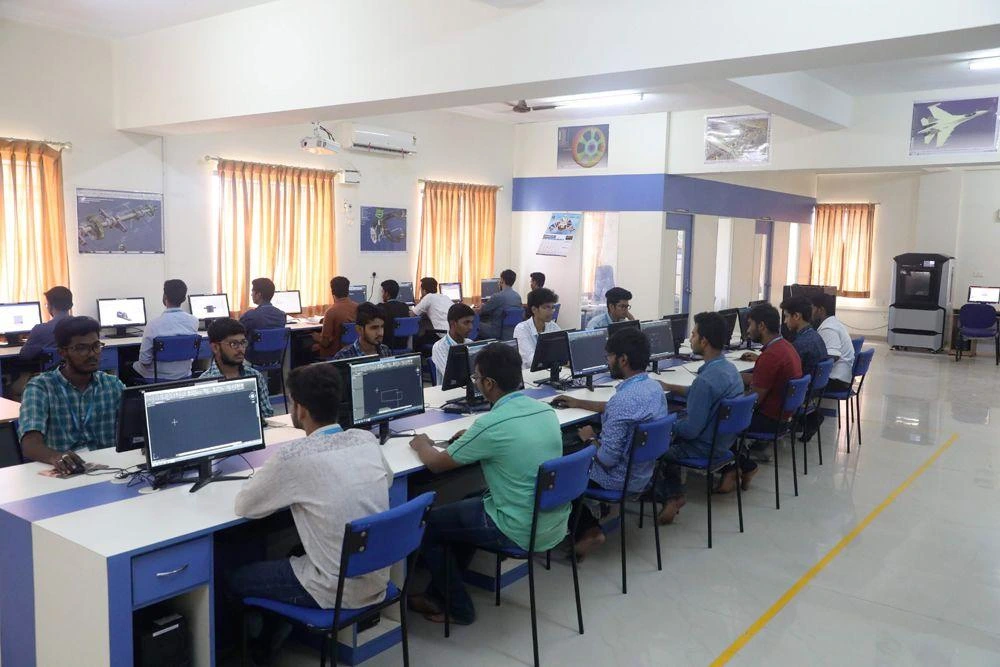
At Ideal Institute of Engineering, students receive practical exposure to computer-aided machine drawing, including 2D drafting and 3D modelling using CAD tools such as AutoCAD and CATIA.
2. Engineering Simulation and CAE
Computer-Aided Engineering (CAE) allows engineers to analyze how a product or component may behave under different conditions before physically manufacturing it.
Students can explore areas such as:
Finite Element Analysis (FEA)
Computational Fluid Dynamics (CFD)
Thermal analysis
Structural analysis
Stress and deformation analysis
Motion simulation
Learning simulation helps students move from simply designing a component to understanding whether that design is likely to perform effectively.
3. Manufacturing and CNC Knowledge
Industry 4.0 does not eliminate the importance of manufacturing fundamentals. Instead, manufacturing is becoming more digitally controlled.
Students should understand:
CNC machining
CAM
Turning and milling
Additive manufacturing
Production planning
Manufacturing processes
Tool selection
Quality control
Process optimization
A mechanical engineer who understands both traditional manufacturing principles and modern digital manufacturing can be valuable in smart factories.
4. Robotics and Industrial Automation
Robotics is one of the most visible parts of Industry 4.0.
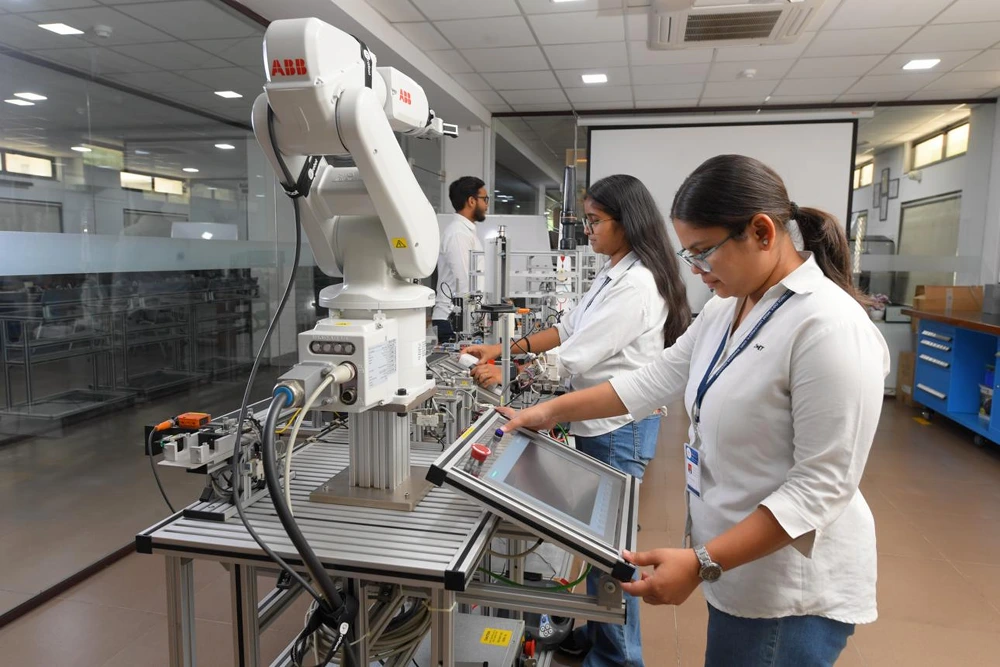
Mechanical engineers may contribute to the design of robotic mechanisms, automated equipment, robotic workstations and manufacturing systems.
Students can start by learning:
Basic robotics
Robot mechanisms
Sensors and actuators
Industrial robots
PLC fundamentals
Motion control
Automation systems
Robot programming concepts
Combining mechanical engineering with basic electronics and programming can create strong interdisciplinary capabilities.
5. Internet of Things and Smart Sensors
The Internet of Things allows machines and devices to communicate and exchange information.
In a smart factory, sensors can monitor parameters such as temperature, pressure, vibration, speed and machine condition.
Mechanical engineering students do not necessarily need to become software developers, but understanding the fundamentals of sensors, data acquisition and connected machines can be extremely useful.
For example, vibration sensors can help identify abnormal machine behavior before equipment failure occurs.
6. Programming and Data Analysis
Programming is becoming an increasingly useful skill for mechanical engineers.
Students can start with languages such as:
Python
MATLAB
C/C++ fundamentals
Programming can be used for engineering calculations, data analysis, automation, simulation and visualization.
For example, Python can help students analyze machine performance data and identify patterns that may not be obvious from manual calculations.
The objective is not necessarily to turn every mechanical engineer into a software engineer. Rather, basic programming gives engineers another tool for solving engineering problems.
7. Artificial Intelligence and Machine Learning Awareness
Artificial intelligence is becoming increasingly relevant to manufacturing and engineering.
AI can be used for areas such as predictive maintenance, defect detection, process optimization and production forecasting.
Mechanical engineering students should understand basic concepts such as:
Machine learning
Predictive maintenance
Computer vision
Data-driven optimization
Anomaly detection
Students who combine mechanical engineering knowledge with AI awareness may be better positioned for emerging industrial roles.
8. Additive Manufacturing and 3D Printing
Additive manufacturing is changing the way certain products and components are designed and produced.
Unlike conventional manufacturing, where material is removed or shaped, additive manufacturing generally builds objects layer by layer.
Mechanical engineering students should understand:
3D printing technologies
Materials used in additive manufacturing
Design for additive manufacturing
Rapid prototyping
Product development
Advantages and limitations of 3D printing
This knowledge can be especially useful in product design, research and development and advanced manufacturing.
9. Problem-Solving and Analytical Thinking
Technology alone does not make a good engineer.
One of the most important Mechanical Engineering Skills is the ability to identify a problem, understand its causes, evaluate alternatives and develop a practical solution.
Engineering students should develop the habit of asking:
What is the problem?
Why is it happening?
What data do I need?
What solutions are possible?
Which solution is technically and economically practical?
This type of thinking remains valuable regardless of how quickly technology changes.
10. Knowledge of Materials and Sustainable Engineering
Modern engineering increasingly focuses on lightweight materials, energy efficiency and sustainability.
Students should understand the properties and applications of materials such as metals, polymers, composites and advanced engineering materials.
Sustainable engineering also requires engineers to consider:
Energy consumption
Material efficiency
Product life cycle
Waste reduction
Recycling
Manufacturing efficiency
Environmental impact
These considerations are becoming increasingly important in automotive, aerospace, energy and manufacturing industries.
11. Communication and Teamwork
Industry 4.0 is highly interdisciplinary.
A mechanical engineer may work with electrical engineers, software developers, data scientists, production managers and automation specialists.
Therefore, technical knowledge must be supported by communication skills.
Students should learn how to:
Explain technical concepts clearly
Prepare engineering reports
Present project results
Work in multidisciplinary teams
Participate in technical discussions
Document engineering decisions
Good communication can make a technically strong engineer much more effective in the workplace.
12. Practical Project Experience
One of the best ways to develop Mechanical Engineering Skills is through projects.
Instead of simply completing academic assignments, students can work on projects that solve practical problems.
Examples include:
Automated material handling systems
Robotic arms
Smart temperature monitoring
Solar-powered mechanical systems
CNC-based projects
3D-printed components
IoT-enabled machine monitoring
Electric vehicle components
Predictive maintenance prototypes
Projects help students understand how different engineering concepts work together.
How Students Can Prepare for Industry 4.0
Developing Industry 4.0 skills does not happen overnight. Students can follow a gradual approach.
Step 1: Build Strong Mechanical Fundamentals
First, understand engineering mechanics, thermodynamics, fluid mechanics, manufacturing, machine design, materials and other core subjects.
Step 2: Learn One CAD Platform Properly
Instead of learning many software packages superficially, become proficient in at least one major CAD tool.
Step 3: Develop Simulation Skills
Learn the basics of FEA, CFD or another relevant simulation technology.
Step 4: Explore Automation and Robotics
Understand sensors, actuators, PLCs and basic robotic systems.
Step 5: Learn Basic Programming
Start with Python or MATLAB and use it for real engineering problems.
Step 6: Build Projects
Combine mechanical components with electronics, sensors, software or automation.
Step 7: Gain Industry Exposure
Internships, industrial visits, workshops and interaction with professionals can help students understand how engineering is applied outside the classroom.
Benefits of Developing Industry 4.0 Skills
Students who develop modern Mechanical Engineering Skills can gain several advantages:
Better understanding of modern manufacturing
Wider career opportunities
Stronger project capabilities
Improved problem-solving ability
Better preparation for internships
Greater confidence with engineering software
Ability to work in multidisciplinary teams
Preparation for emerging technologies
Better foundation for higher studies and research
Most importantly, students become more adaptable. Since technology continues to evolve, the ability to learn new tools may be just as important as knowing today’s tools.
Career Opportunities for Mechanical Engineers in Industry 4.0
The combination of mechanical engineering and digital technology can lead to career opportunities such as:
Mechanical Design Engineer
CAD Engineer
CAE Engineer
Manufacturing Engineer
Automation Engineer
Robotics Engineer
Production Engineer
Quality Engineer
CNC/CAM Engineer
Product Development Engineer
Industrial Engineer
Maintenance Engineer
Automotive Engineer
R&D Engineer
The exact job title and responsibilities vary by company, but the underlying requirement is increasingly similar: engineers need strong fundamentals and the ability to work with modern technologies.
How IIE Kalyani Can Help Students Build Industry-Ready Skills
Mechanical engineering education becomes more meaningful when students have opportunities to apply classroom concepts in practical environments.
Ideal Institute of Engineering, Kalyani, provides laboratory facilities covering important areas of mechanical engineering, including manufacturing technology, fluid mechanics, thermal engineering, IC engines, dynamics of machines, metrology, machine tools and design practice.
The institute’s Computer Aided Machine Drawing Laboratory also provides practical exposure to CAD-based 2D drafting and 3D modelling.
Such practical learning can help students understand the relationship between engineering theory, digital design and real-world applications.
For students preparing for Industry 4.0, the ideal approach is to combine classroom learning with laboratory work, technical projects, software training, internships and continuous self-learning.
Frequently Asked Questions About Mechanical Engineering Skills
What are the most important Mechanical Engineering Skills for Industry 4.0?
Important skills include CAD and 3D modelling, engineering simulation, manufacturing, CNC/CAM, robotics, automation, IoT, programming, data analysis, problem-solving and communication.
Do Mechanical Engineering students need to learn programming?
Basic programming is increasingly useful. Students can start with Python or MATLAB and use programming for engineering calculations, data analysis, automation and simulation.
Is CAD still important in Industry 4.0?
Yes. CAD remains a fundamental tool for modern product design and engineering. It also connects with simulation, manufacturing and digital product-development workflows.
Can Mechanical Engineers work in robotics and automation?
Yes. Mechanical engineers can contribute to robot mechanism design, automated equipment, manufacturing systems and robotic integration. Knowledge of electronics, sensors, controls and programming can further strengthen their capabilities.
What is the role of AI in Mechanical Engineering?
AI can support predictive maintenance, quality inspection, process optimization, production planning and engineering analysis. Mechanical engineers with basic AI and data-analysis knowledge can participate in these applications.
How can students develop Mechanical Engineering Skills while studying?
Students can develop skills through laboratory work, CAD practice, technical projects, internships, industrial visits, workshops, online courses and participation in engineering competitions.
What skills should a Mechanical Engineering student learn first?
Students should begin with strong engineering fundamentals and engineering drawing, followed by CAD, manufacturing knowledge and practical problem-solving. They can then gradually add simulation, programming, automation, IoT and data-analysis skills.
Conclusion
Industry 4.0 is not replacing mechanical engineering; it is changing the way mechanical engineers work.
The machines, manufacturing systems and physical products of the future will increasingly interact with sensors, software, automation and data. As a result, students need a combination of traditional engineering knowledge and modern digital capabilities.
Developing the right Mechanical Engineering Skills can help students become more adaptable, confident and industry-ready. CAD, simulation, manufacturing, robotics, programming, IoT, data analysis and problem-solving are valuable additions to a strong mechanical engineering foundation.
For engineering students, the goal should not be to learn every new technology at once. Instead, they should build strong fundamentals, develop practical skills, work on meaningful projects and continuously learn new technologies.
That combination can help today’s Mechanical Engineering students prepare for the opportunities created by Industry 4.0.